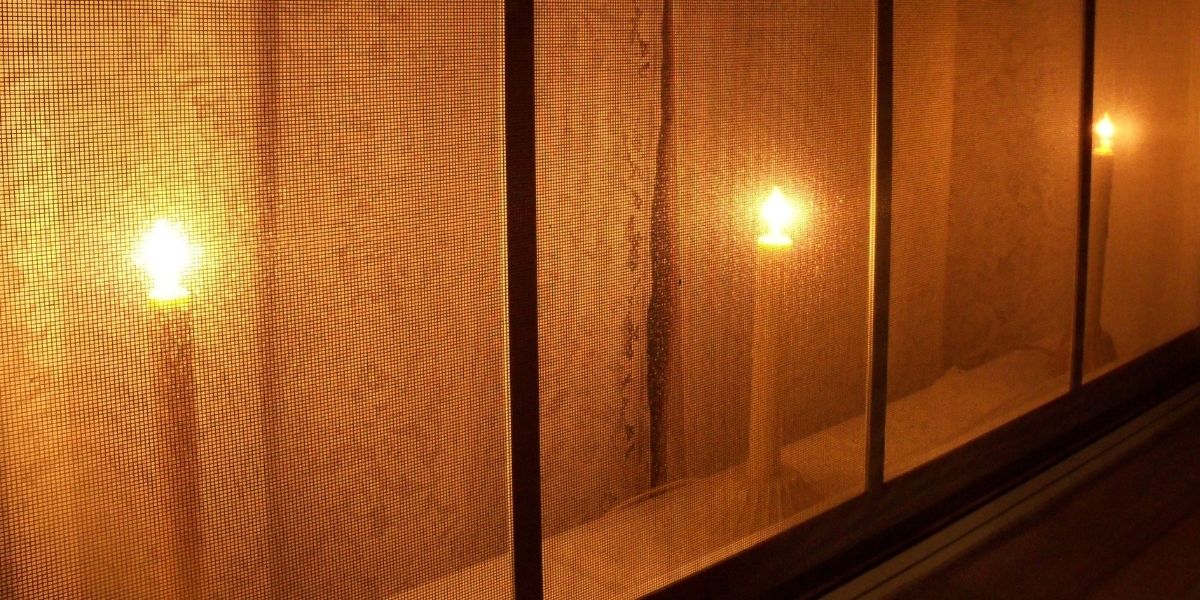
When I was young, I lived in the Netherlands, where winter days were short and darkness arrived early. By mid-afternoon, if you took a walk around the neighbourhood, you would see lights and candles glowing in windows, easily visible because of a long-standing Dutch tradition of not using heavy curtains. At Christmas time, special stars or candles were placed in windows, and sometimes you would see Jewish Chanukah candles as well. Looking further inside, you might glimpse lights on a Christmas tree or the warm flicker of a fireplace. As night fell, these lights quietly proclaimed to those passing by that there was life inside. Each small flame pushed back the darkness a little.
Here in Australia, we have to wait much longer for night to fall, for the lights to shine against the darkness. We even have to keep children awake a little later so they can see houses decorated with Christmas lights. The experience is different, shaped by long summer evenings rather than early winter nights, but the instinct is the same: to mark the season with light and let its glow reach into the darkness.
Long before the birth of Jesus, the prophet Isaiah spoke hope to a weary and fearful people: “The people walking in darkness have seen a great light; on those living in the land of deep darkness a light has dawned” (Isaiah 9:2). The Gospel of John picks up this promise, presenting the story of Christmas as the coming of light into darkness. John declares, “The light shines in the darkness, and the darkness has not overcome it” (John 1:5), and goes on to say, “The true light that gives light to everyone was coming into the world” (John 1:9). Christmas proclaims that God does not ignore the darkness of the world. God enters it, bringing a light that cannot be extinguished.
We may not always feel the pressing weight of darkness, but it is still there. We still need to be reminded of the power of light. And as I write this, the day after the attack at Bondi in Sydney, we are painfully aware of the of darkness in our world: showing up in fear, grief, injustice, and violence. It is a sobering reminder that darkness can intrude into sunny afternoons, into ordinary places and ordinary lives. Yet it is precisely into this kind of darkness that the Christmas story still speaks. It calls us to hold fast to the truth that there is light and hope in this world.
Christmas calls us to live out the costly conviction that light, not hatred, has the power to overcome darkness. In Romans 12, after grounding everything in God’s mercy, the Apostle Paul urges Christians to live out this light-shaped hope, to live as transformed people, and partner with God in his redemptive plan to “not be overcome by evil, but overcome evil with good” (Romans 12:21). Followers of Jesus are called to be people who open our homes and our lives to others, who gather in both grief and celebration, who practise generosity, who seek peace, who bless and do not curse, and who bear witness to the light, love, and hope of Jesus.
Speaking from his context of injustice and social division in the United States, Martin Luther King Jr. echoed this same conviction, proclaiming in his 1963 sermon Loving your enemies that “Darkness cannot drive out darkness: only light can do that. Hate cannot drive out hate: only love can do that.” King knew firsthand that these were not sentimental words, but costly ones. Light and love are the forces that truly transform.
And so, this Christmas, we remember that the light is not something we create for ourselves. It is given to us. Jesus declares, “I am the light of the world. Whoever follows me will never walk in darkness, but will have the light of life” (John 8:12). That means that as we walk with him, like candles in a window, we push back the darkness a little, letting Christ shine into the world. In every act of love, every word of hope, every gesture of grace, we join him in bringing light to the places that need it most. This Christmas, may we walk in that light and let it shine through us.

' fill='none' stroke='%23f70' stroke-linecap='round' stroke-linejoin='round' stroke-width='1'/%3E%3C/svg%3E)
'%3E%3Cpath id='Path_12609' data-name='Path 12609' d='M30.328,19.017a4.79,4.79,0,0,1-.426.728,1.506,1.506,0,0,1-1.215.507H1.712A1.568,1.568,0,0,1,0,18.659Q0,10.131,0,1.6A1.559,1.559,0,0,1,1.564.012c.108,0,.217,0,.326,0Q15.126.011,28.361,0a1.8,1.8,0,0,1,1.967,1.245Zm-2.019.048c-.081-.109-.131-.181-.186-.248l-4.9-6.051-1.489-1.841a.567.567,0,0,1-.051-.735.525.525,0,0,1,.65-.217,1.044,1.044,0,0,1,.4.327q3.08,3.792,6.149,7.592c.07.087.144.17.248.292V1.955c-.1.071-.171.118-.239.169C24.932,5.1,20.958,8.051,17.017,11.049a3.007,3.007,0,0,1-3.7,0C9.373,8.051,5.4,5.1,1.435,2.124c-.072-.054-.147-.1-.237-.167V18.174c.1-.11.161-.18.221-.254L6.3,11.891c.441-.545.88-1.091,1.323-1.634.284-.348.642-.418.92-.186s.281.561,0,.915c-.049.062-.1.124-.147.185L2.23,18.788c-.065.081-.125.166-.207.276ZM28.159,1.2H2.185c.131.1.218.177.309.245L14.07,10.133a1.621,1.621,0,0,0,2.187,0l10.8-8.1L28.159,1.2' transform='translate(0 -0.001)' fill='%23f70'/%3E%3C/g%3E%3C/svg%3E)